Roles of SINET6 in Intellectual Platform Formation Project Through Collaboration of Five Universities in Shikoku
Kagawa University jointly provides university education based on the e-Knowledge intellectual platform formation project being conducted through the collaboration of five universities in Shikoku. We interviewed Professor Toshihiro Hayashi, Head of the Integrated Center for Informatics, Kagawa University, about the overview of the inter-university collaboration and the roles that SINET6 plays in it. (Interview date: July 16, 2025)
Please tell us about the inter-university collaboration based on e-Knowledge and the roles that Kagawa University plays in it.
Hayashi: In the project for joint provision of university education through inter-university collaboration based on e-Knowledge in Shikoku, five universities based in Shikoku—namely Kagawa University, Tokushima University, Naruto University of Education, Ehime University and Kochi University—aim to provide effective education through mutual collaboration in sharing educational resources they own and through effective utilization of the e-learning platform. In this project, Kagawa University serves as the core institution and has set up the University Consortium for e-Learning, Shikoku Center. Its branches are established at the four other universities. Specifically, this center runs joint courses using the e-learning platform and full e-learning mass classes for hundreds of students each, among other activities.
The Information Technology and Media Center in the Integrated Center for Informatics, Kagawa University, acts as an organization in charge of intra-university information platforms. It manages, maintains and improves networks between the inside and the outside of the university and between campuses to provide a network environment for educational and research activities, paperwork, remote lectures through connection with the Japan Gigabit Network (JGN) outside the university, local medical information services, and other services.
What achievements have you made so far?
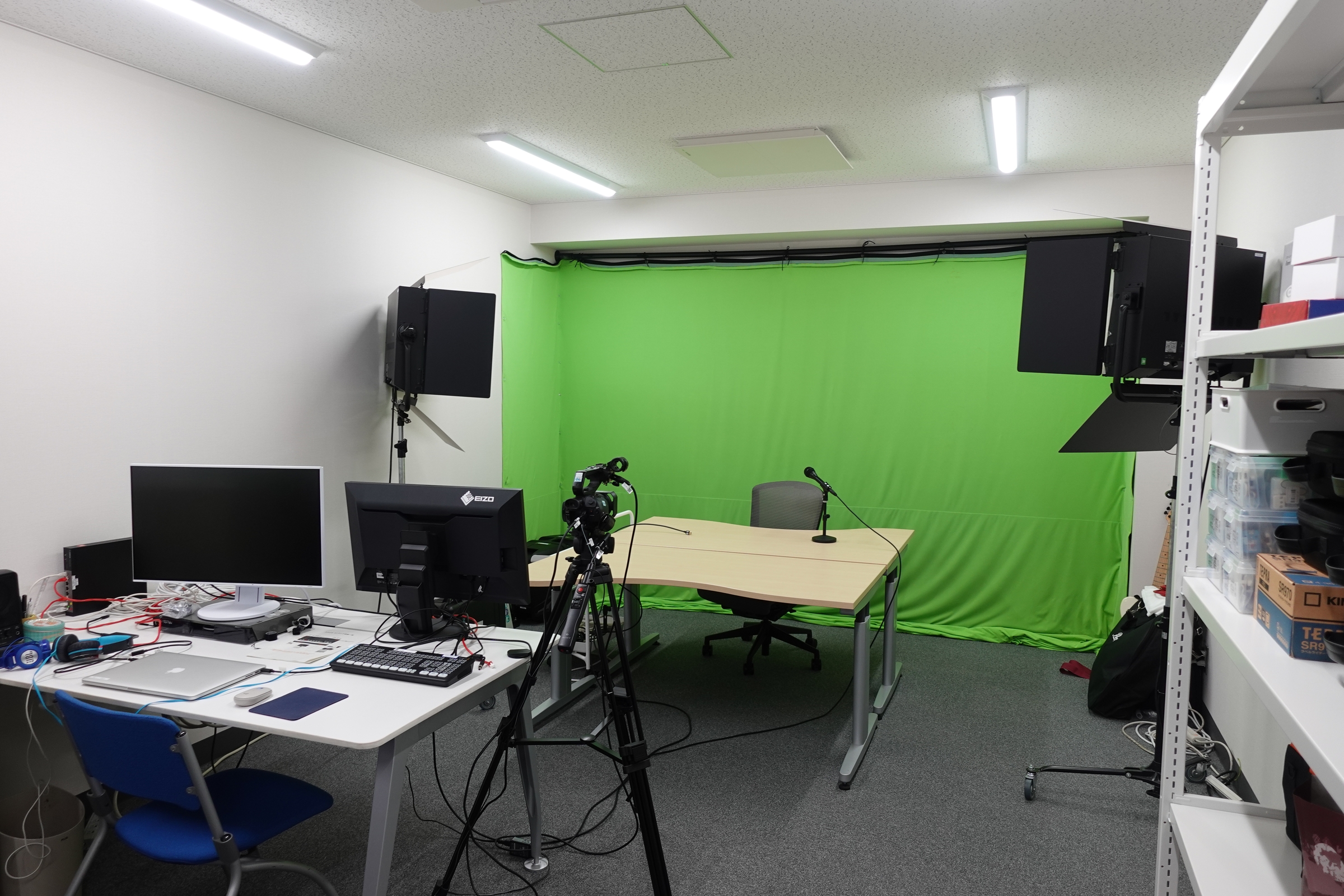
Hayashi: The scale is now far larger than at the time of the previous interview in 2009. For example, the number of courses provided has increased five- or sixfold to nearly 60. The number of students registering for courses jumped from less than 1,000 at the previous time to 10,000 or more. I suppose this is due to specialization in providing on-demand e-learning courses. Students seem to find on-demand courses advantageous in the sense that they can take them without time and place constraints. Actually, their report submissions suggest that they take courses at different time slots. Among the courses attracting many registrations, some have 1,000 or more registrants. On the whole, many of the students taking the courses are from Kagawa University. However, courses are registered and taken evenly by students from other universities.
With regard to evaluation of achievements, there used to be some lectures in which examinations alone were taken in person. Today, most courses require online submission of reports. You may feel that two-way communication is difficult in e-learning. However, we often receive separate questions actively sent from students by email, so it might be that the format of on-demand e-learning is accepted with little hesitation by today’s students.
The project has encouraged collaboration with the other universities, hasn’t it?
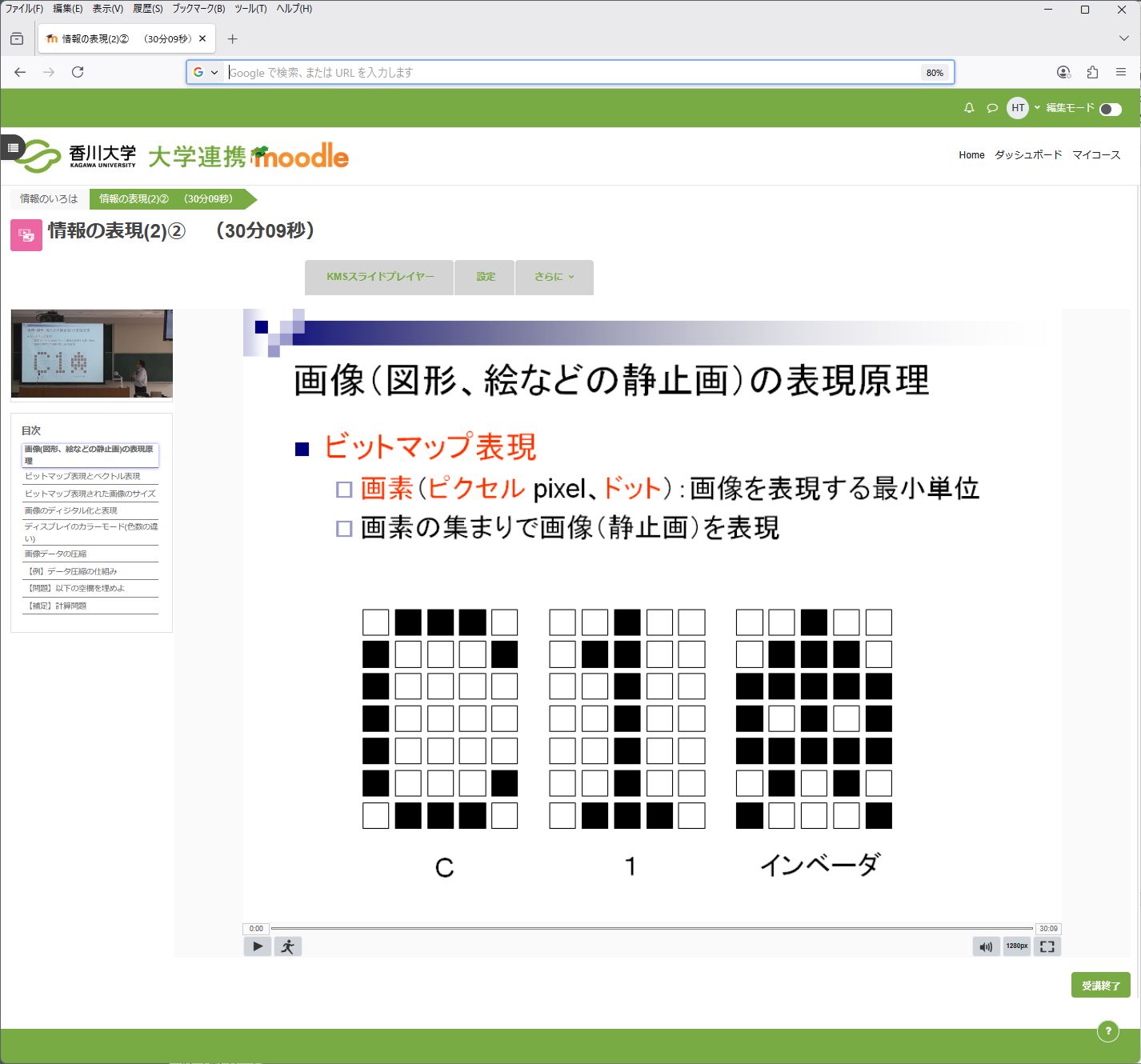
Hayashi: One advantage of inter-university collaboration through e-learning is that attractive lectures with unique characteristics are not accessible solely inside specific universities, but are open to students at other universities as well. In other words, the inter-university collaboration paves the way for providing students with a wide variety of courses that cannot be offered by a single university. For example, Ehime University provides a course on Insects and the Environment, and Kochi University offers a course on The World of Manga. Specialty courses like these not offered at Kagawa University can now be taken by students interested in them.
Following the expansion of e-learning, Kagawa University has seen some changes in its organizational structure. In the past, e-learning was operated by a small team. Today, more staff members are involved. The entire university, including not only teaching staff but also personnel in other functions, is working to build an effective structure. I feel it also has another positive effect of closing the distance between teaching staff and other staff and stopping sectionalism.
Can you tell us about collaboration with local communities as well?
Hayashi: Some courses are open to adults and high school students for lifelong learning purposes. It may be desirable that we introduce a scheme in the future under which credit earned by high school students taking a course will be recognized, for example, after they enter Kagawa University.
In addition, from the second half of the current (2025) academic year, we will be jointly producing and providing courses with Shikoku Economic Federation. It is envisioned that businesses will produce content, that universities will provide it in form of lectures, and that their teaching staff will assess students’ achievements. I suppose that this regional collaboration will present the appeal of local businesses to students in four prefectures constituting the Shikoku region.
So, the network is becoming increasingly important?
Hayashi: Yes, it is. As the number of students taking e-learning courses increases, a more stable network is required. Especially for term-end evaluations, a high percentage of students tend to submit their reports just before the deadline. In the aforementioned courses with 1,000 or more registrants, 300 to 400 students submit their reports just before the deadline. If the network is unstable, we may not receive their submissions, and problems may occur. A high-speed stable network environment provided by SINET6 is of great help.
Please tell us about the network configuration as well.
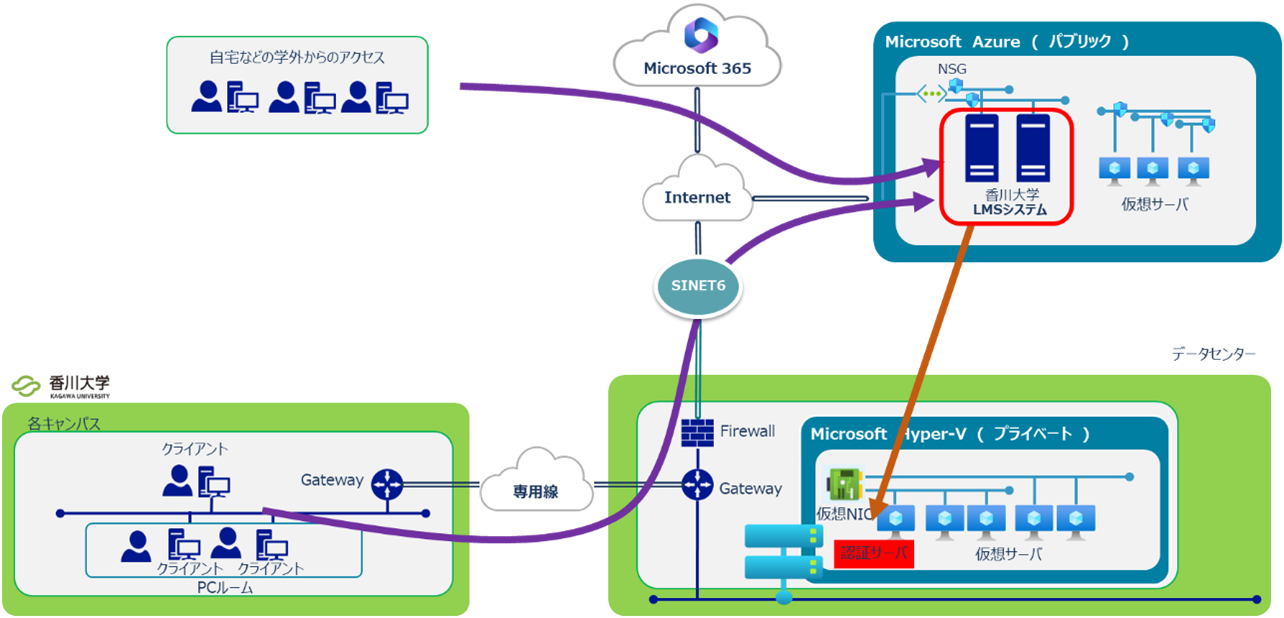
Hayashi: In terms of the basic network configuration, Kagawa University Learning Management System (LMS) is placed in a public cloud on Microsoft Azure. From inside the university, users can connect to the LMS via SINET6. At the time of authentication, the internal authentication server in the private cloud inside the university is used. In this event, data takes an encrypted route prepared in advance, not the Internet, to perform secure authentication.
Content of e-learning lectures provided are placed on the LMS at individual universities offering them. With collaboration in Shibboleth authentication (single sign-on) provided by the Academic Access Management Federation in Japan (GakuNin), students can view the content with the use of their IDs and passwords provided by their universities. I feel we will need to discuss mutual sharing of content, storage at a place resilient to disasters such as commercial data centers, and sharing of cost burdens in connection with the business continuity plan (BCP) in the event of a disaster, such as a possible Nankai Trough megaquake.
What is the future outlook for the project?
Hayashi: After the COVID-19 pandemic, teaching staff and students are both now accustomed to using the LMS, so a shift from the distribution of conventional hard copy materials to the distribution of electronic media is underway. The number of lectures is set to ensure that the 60 e-learning courses currently offered can be operated stably. If we can reduce paperwork burdens on teaching staff by making use of AI for example, we will be able to increase the number of courses and the number of students who can take individual courses. Apart from that, e-learning courses tend to be concentrated in science and engineering disciplines, so we will work to increase courses in the humanities and social sciences. In addition, as I explained earlier, the course on Insects and the Environment at Ehime University and the course on Computers and Education Part 1 here at Kagawa University have received more than 1,000 registrations. For distinctive courses like these, it may be difficult to attract a sufficient number of students at a single university. Collaboration between universities in sharing such courses will provide lots of students with opportunities to study them.
Since SINET provides a stable network environment, it ensures that e-learning videos can be accessed and viewed by a large number of students without problem. The network environment will become increasingly important in the future. I hope that we can collaborate even more closely with SINET.